

For many agricultural students, real-world experience transforms textbook learning into meaningful practice. A team of students from the University of Eldoret’s Department of Soil Science recently experienced this firsthand through a month-long field attachment in Bomet County, Kenya, as part of the HABITAT Project (Harnessing Pasture Biodiversity and Productivity) — funded by the Global Centre on Biodiversity and Climate (GCBC) and supported by the International Livestock Research Institute (ILRI) and Bangor University.
Bridging Theory and Practice
The fieldwork offered students a chance to take concepts from the classroom and apply them to real-life challenges on smallholder dairy farms. The HABITAT Project focuses on improving pasture management, enhancing biodiversity, reducing greenhouse gas emissions, and building climate resilience in pastoral landscapes — goals that are as critical for food security as they are for environmental sustainability.
Each student had a unique research focus:
- Winnie Chepkemoi collected pasture and legume samples to assess their nutritional quality and potential to reduce methane emissions when included in cattle diets — contributing to climate-smart feeding strategies aligned with Kenya’s national climate goals.
- Caroline Chepkoech Kitur investigated how soil properties relate to pasture biodiversity and function, exploring how different plant species influence soil carbon storage, water retention, and ecological productivity.
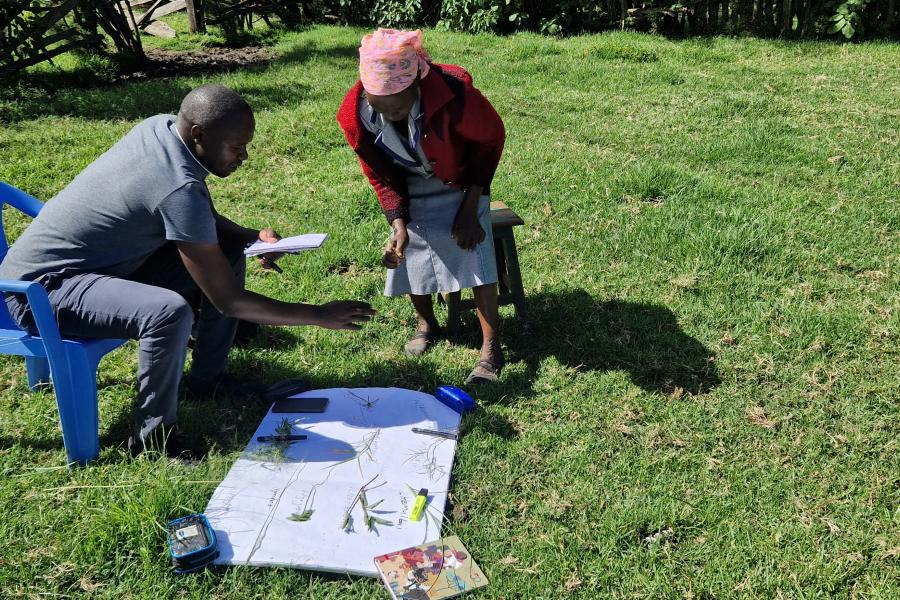
- Daniel Rotich focused on identifying pasture species and used cultural domain analysis to understand how local farmers perceive and categorize their pasture landscapes — crucial insight for developing recommendations that resonate with local experience.
Learning from the Land and its Keepers
The students were struck by the depth of ecological knowledge among the local farming community. Far from being merely subjects of study, farmers shared profound insights about plant characteristics, seasonal growth patterns, and practical livestock management techniques honed over generations. One striking example was local knowledge of Trifolium (locally known as Ndabibit) and its effects on cattle, demonstrating how indigenous understanding complements formal scientific inquiry.
This exchange of knowledge reminded the students that expertise exists both inside and outside the classroom — and that sustainable agricultural practices are most effective when they integrate scientific research with local wisdom.
Fieldwork Routines and Challenges
The team carried out structured data collection using standardized sampling methods across multiple farms, carefully labeling, storing, and transporting samples for later lab analysis. Despite logistical challenges such as poor road access, clear planning, strong collaboration, and the welcoming attitude of farmers ensured the work was both productive and rewarding.
Towards Sustainable Futures
With samples now in the lab, the students’ findings will support HABITAT’s broader goals: increasing pasture biodiversity and drought resilience, lowering greenhouse gas emissions, improving smallholder productivity, and strengthening farmer-to-farmer knowledge sharing.
The experience was more than an academic exercise — it was a journey into the heart of sustainable agriculture, reinforcing a shared commitment to climate-smart food systems and community-led innovation.
Article courtesy of: https://www.bangor.ac.uk/habitat/news/from-classroom-to-grazing-fields-…